Reimagining Cafeteria Food Ordering
Reimagining Cafeteria Food Ordering
Streamlining global cafeteria experiences through delightfully designed products
Streamlining global cafeteria experiences through delightfully designed products
TL:DR
TL:DR
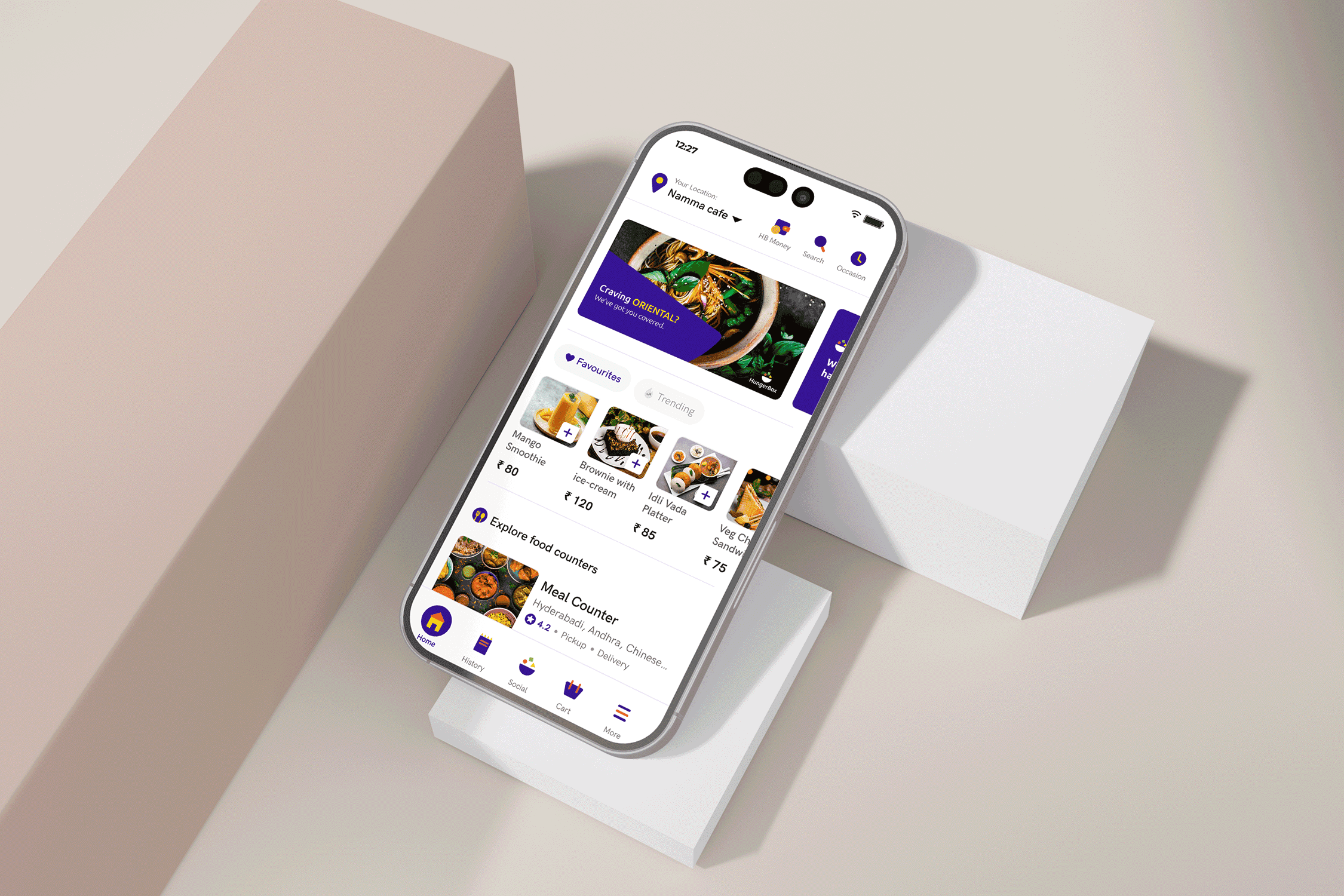
Redesigned HungerBox’s cafeteria experience by shifting the focus from mobile ordering to the entire operational system behind the counter.
By building an integrated ecosystem -consumer app, vendor POS, and kitchen management system, we streamlined high-volume cafeteria operations, reducing peak wait times from 60 to 25 minutes, achieving ~98% vendor adoption, improving app ratings from 2.3 to 4.2, and unlocking ₹5Cr in annual hardware revenue.
Redesigned HungerBox’s cafeteria experience by shifting the focus from mobile ordering to the entire operational system behind the counter.
By building an integrated ecosystem -consumer app, vendor POS, and kitchen management system, we streamlined high-volume cafeteria operations, reducing peak wait times from 60 to 25 minutes, achieving ~98% vendor adoption, improving app ratings from 2.3 to 4.2, and unlocking ₹5Cr in annual hardware revenue.
The Problem
The Problem
At 12:30 PM, a corporate cafeteria serving 5,000 employees turns into controlled chaos.
It becomes overwhelming for users to come to cafeteria, decide what to eat, place order, wait for its preparation and consume it within a short 30–45 minute lunch window.
Meanwhile cafeterias must serve thousands of meals, yet many still rely on manual systems.
Orders are written on slips.
Payments happen at crowded counters.
Kitchen teams rely on verbal coordination.
The result is predictable:
Employees spend a large part of their lunch break waiting in line. the need visibility on which counters are open and what items are available
Vendors struggle to manage order surges
Kitchens lack visibility into preparation priorities
At HungerBox, we set out to understand why cafeteria operations at scale still felt chaotic and how technology could solve it.
At 12:30 PM, a corporate cafeteria serving 5,000 employees turns into controlled chaos.
It becomes overwhelming for users to come to cafeteria, decide what to eat, place order, wait for its preparation and consume it within a short 30–45 minute lunch window.
Meanwhile cafeterias must serve thousands of meals, yet many still rely on manual systems.
Orders are written on slips.
Payments happen at crowded counters.
Kitchen teams rely on verbal coordination.
The result is predictable:
Employees spend a large part of their lunch break waiting in line. the need visibility on which counters are open and what items are available
Vendors struggle to manage order surges
Kitchens lack visibility into preparation priorities
At HungerBox, we set out to understand why cafeteria operations at scale still felt chaotic and how technology could solve it.
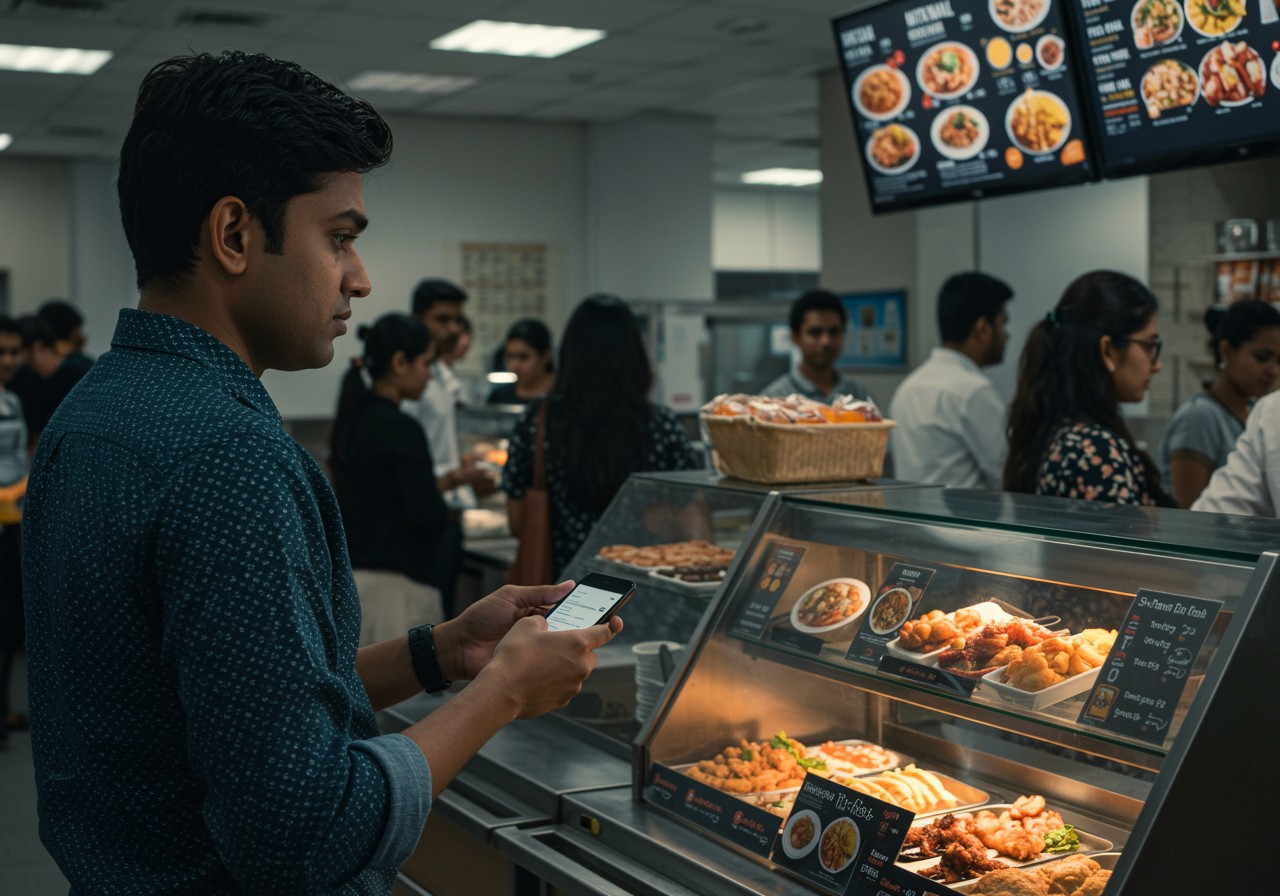
it becomes overwhelming for the user to come to cafeteria, decide what to eat, place order, wait for preparation and consume it within 30-45 min window
Setting the Context
Setting the Context
These exciting problem statements made me join HungerBox in Dec'19.
HungerBox back then was already a "big cafeteria" serving large volumes but there was no emphasis on user experience.
The mobile app was functional, you could only place orders, and for Kitchen Operators we did not even have a solution.
Additionally the brand lacked clarity, strong recall & trust.
For a company aiming to become the operating system for workplace cafeterias, it needed to have a better user experience with strong brand identity.
These exciting problem statements made me join HungerBox in Dec'19.
HungerBox back then was already a "big cafeteria" serving large volumes but there was no emphasis on user experience.
The mobile app was functional, you could only place orders, and for Kitchen Operators we did not even have a solution.
Additionally the brand lacked clarity, strong recall & trust.
For a company aiming to become the operating system for workplace cafeterias, it needed to have a better user experience with strong brand identity.
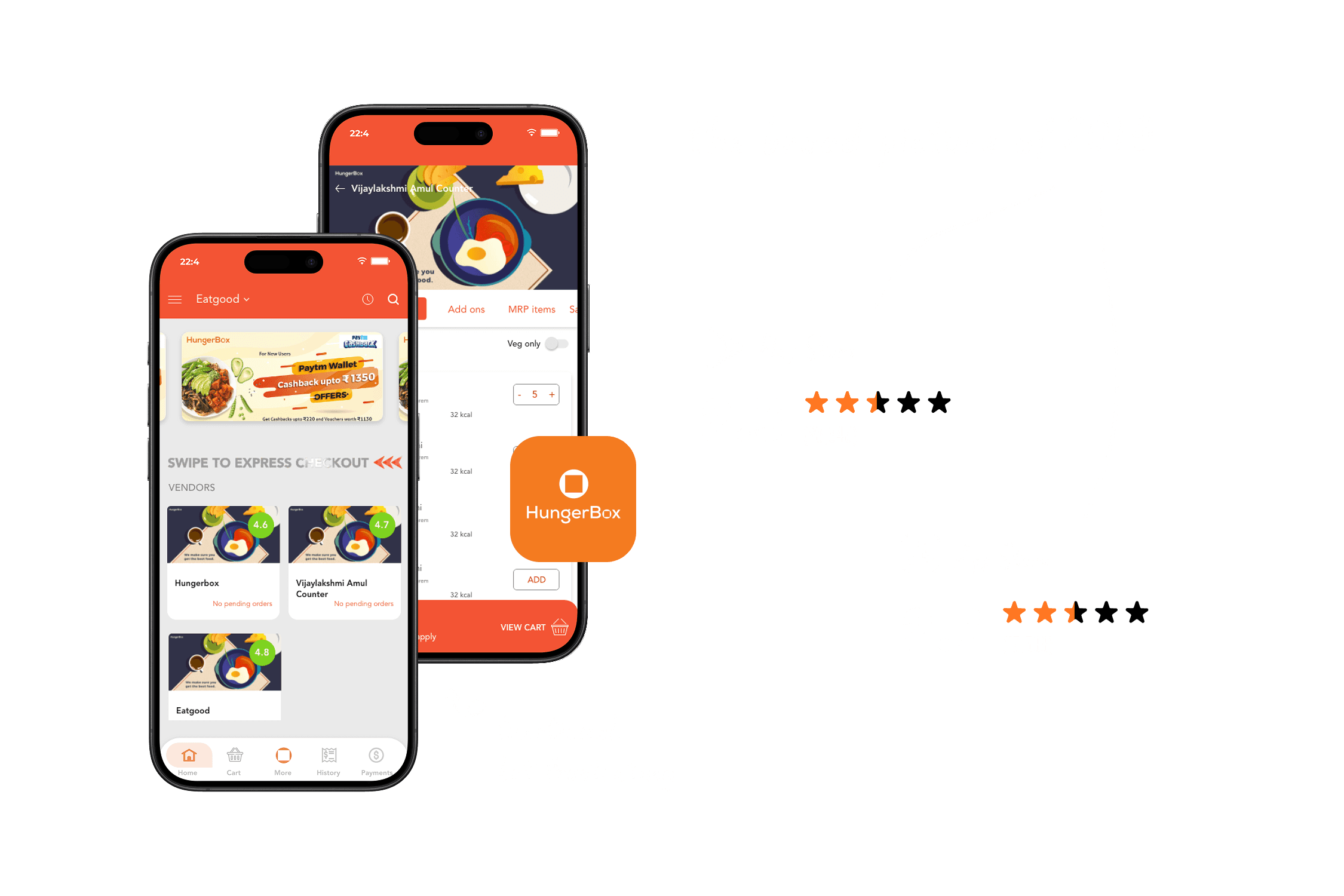
frustrating, inconsistent app with poor rating
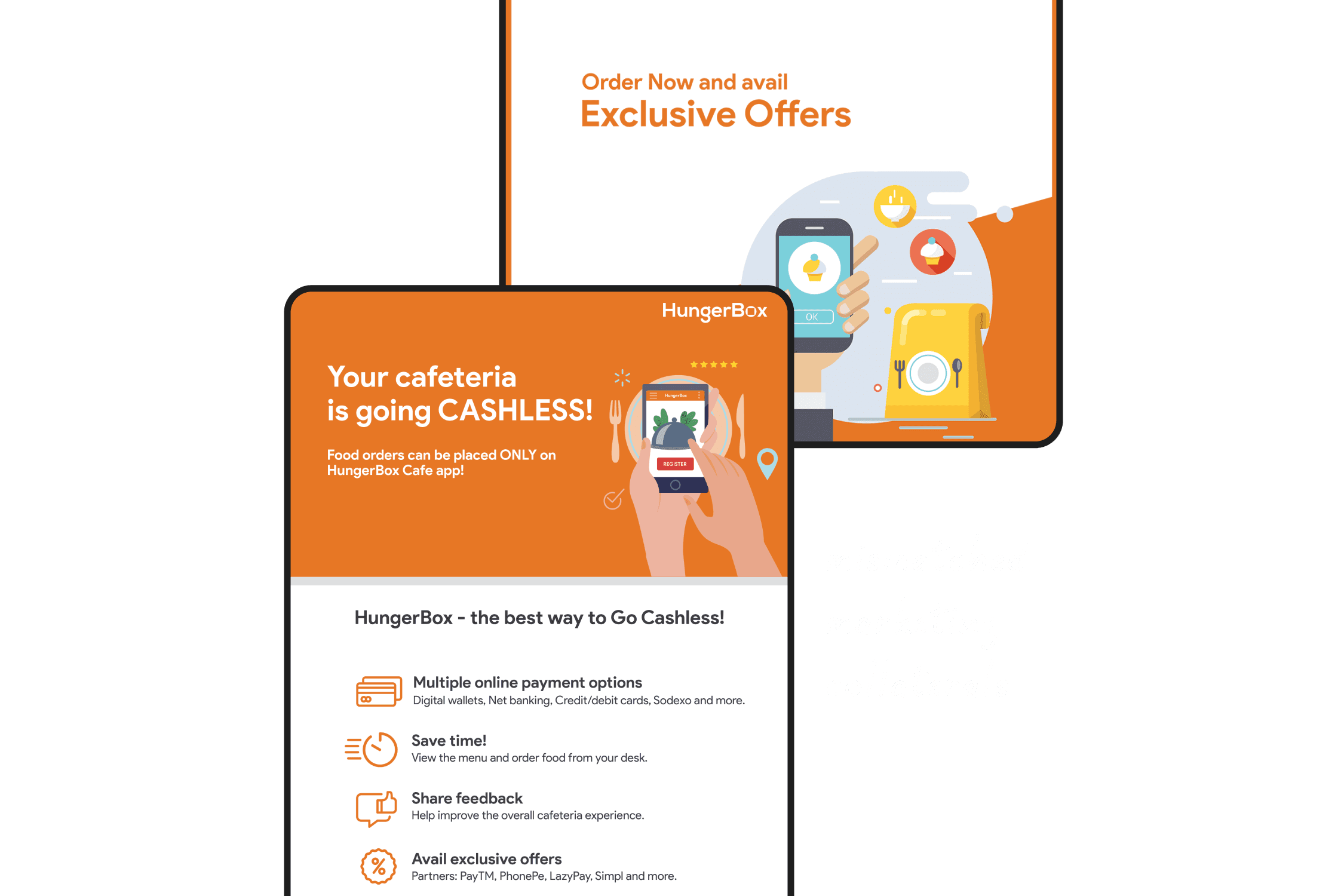
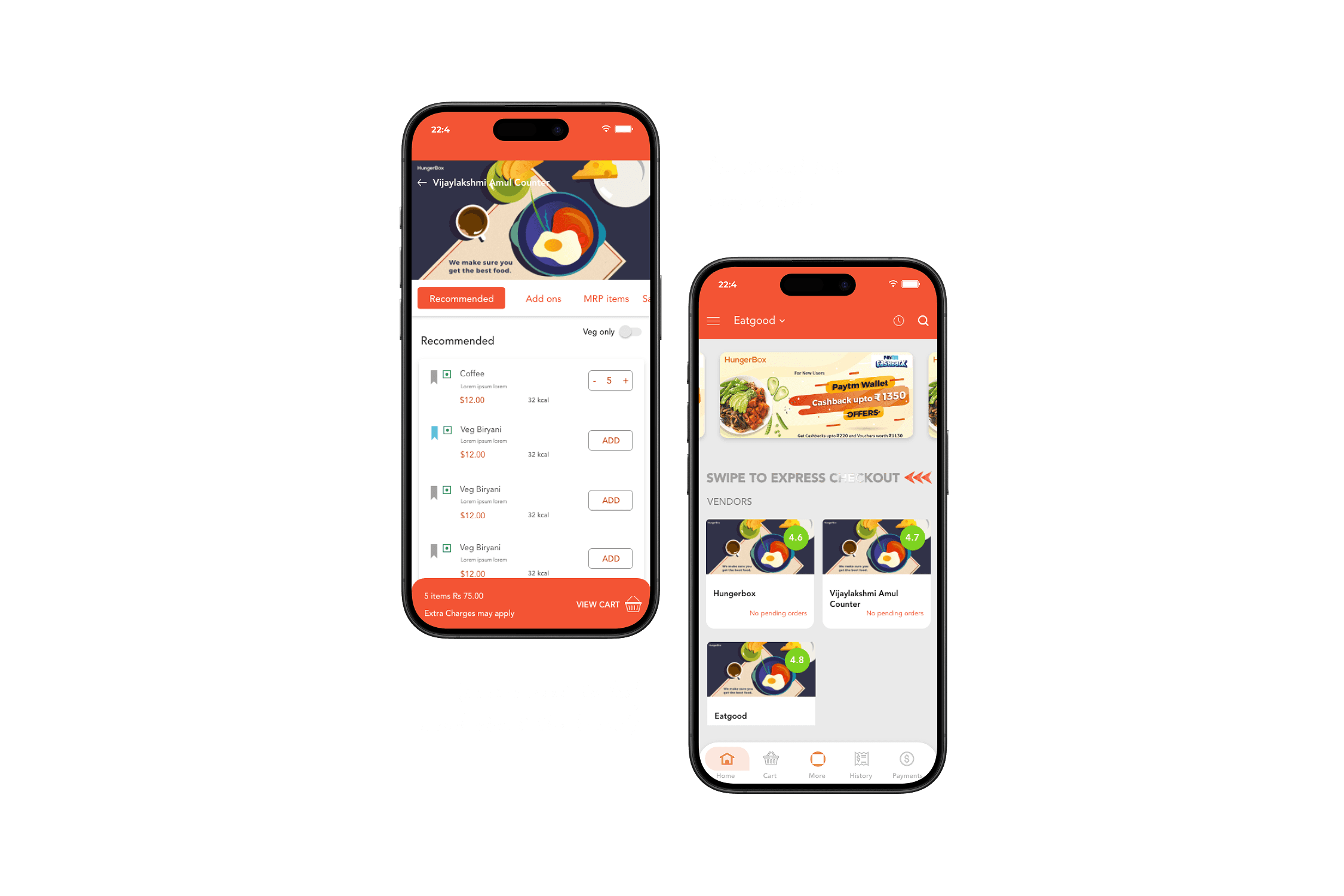
inconsistent branding across system
If HungerBox wanted to scale as an ecosystem product,
If HungerBox wanted to scale as an ecosystem product,
the app had to Grow Up!
the app had to Grow Up!
Rebuilding the Brand Identity
Rebuilding the Brand Identity
One of the first initiatives I led the end-to- end rebranding effort.
It needed to become a part of everyone's corporate life, think: An accenture employee who's life revolves around, ID Cards, MS Teams, JIRA, office cabs etc, similarly, HungerBox it should become something they can't live without, their office cafeteria.
Our goal was to create a visual identity that reflected:
energy
reliability
modern workplace culture
Working closely with marketing and engineering teams, the brand evolved from an orange, fragmented interface into a cohesive purple identity, which became strongly associated with the platform.
One of the first initiatives I led the end-to- end rebranding effort.
It needed to become a part of everyone's corporate life, think: An accenture employee who's life revolves around, ID Cards, MS Teams, JIRA, office cabs etc, similarly, HungerBox it should become something they can't live without, their office cafeteria.
Our goal was to create a visual identity that reflected:
energy
reliability
modern workplace culture
Working closely with marketing and engineering teams, the brand evolved from an orange, fragmented interface into a cohesive purple identity, which became strongly associated with the platform.
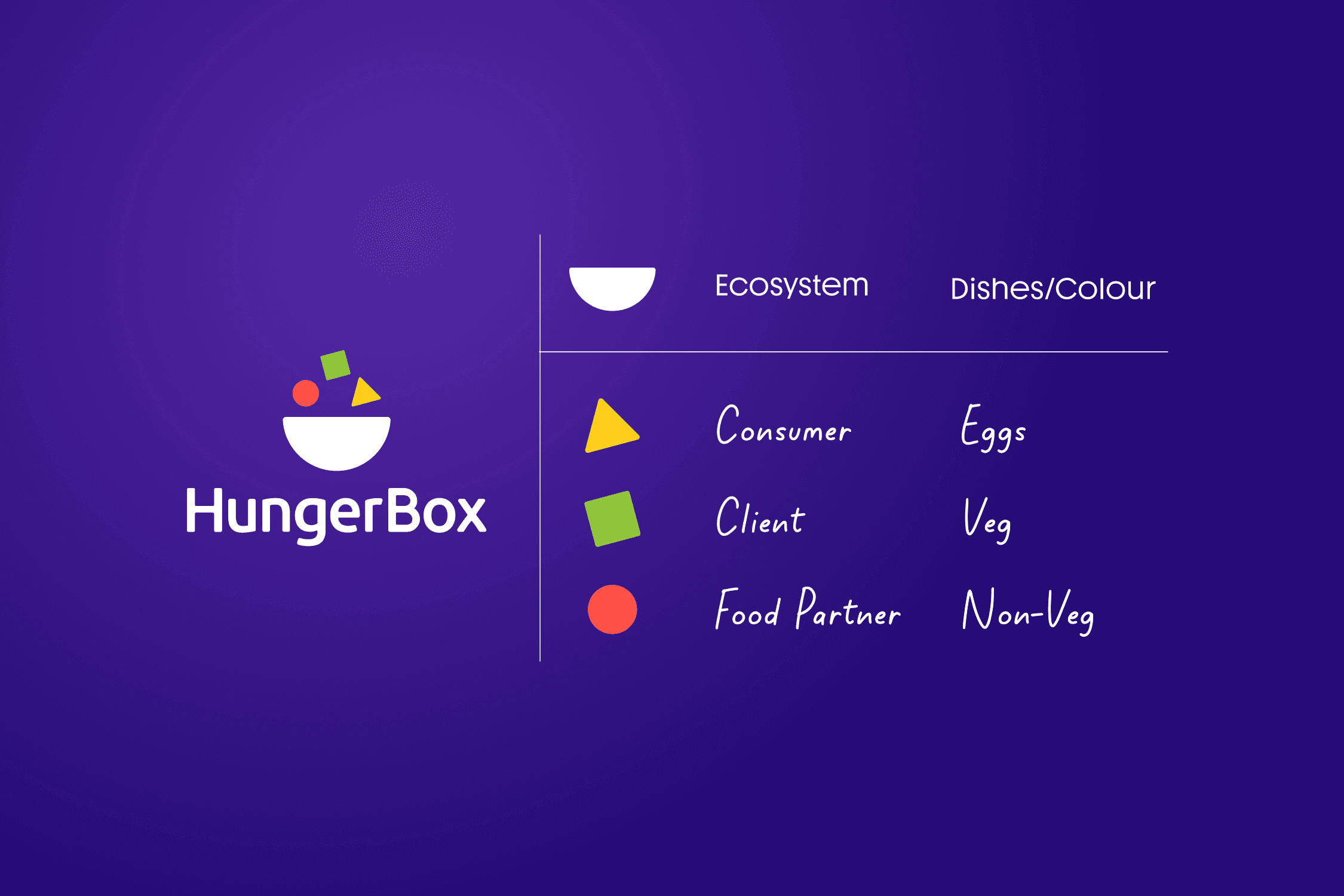
philosophy behind HungerBox logo
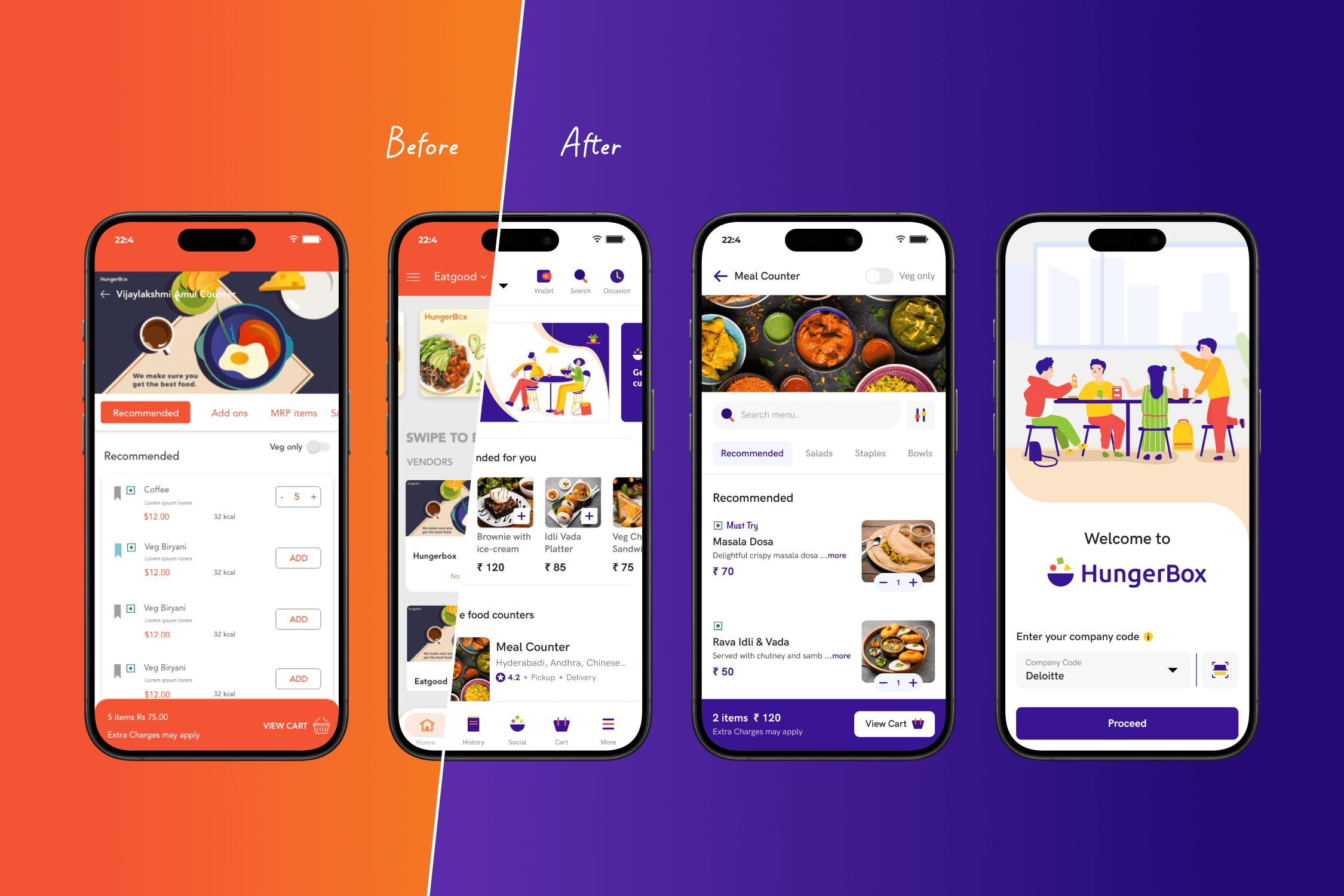
the revolution from orange to purple
allright the branding looks great buttt
allright the branding looks great buttt
what about the pain points??
what about the pain points??
The First Hypothesis
The First Hypothesis
Our early assumption was simple:
If employees could order food from their phones, queues would disappear.
We rolled out mobile ordering across multiple campuses where one could browse menu and place orders but……
'Queues still existed.'
Digital orders made user ordering and browsing efficient but food preparation during peak hours was still a nightmare for vendors
Our early assumption was simple:
If employees could order food from their phones, queues would disappear.
We rolled out mobile ordering across multiple campuses where one could browse menu and place orders but……
'Queues still existed.'
Digital orders made user ordering and browsing efficient but food preparation during peak hours was still a nightmare for vendors
The
Actual Problem
The
Actual Problem
The issue wasn’t ordering, it was order processing.
Behind the scenes in a food counter, was inefficient & outdated:
manual order tracking
Poor prioritisation of food preparation
Zero KOT visibility
Zero menu management
Orders from the mobile app simply added another stream of requests to already chaotic processes. The real challenge wasn't order placing but, was an inefficient operationally heavy process behind the counter.
The issue wasn’t ordering, it was order processing.
Behind the scenes in a food counter, was inefficient & outdated:
manual order tracking
Poor prioritisation of food preparation
Zero KOT visibility
Zero menu management
Orders from the mobile app simply added another stream of requests to already chaotic processes. The real challenge wasn't order placing but, was an inefficient operationally heavy process behind the counter.
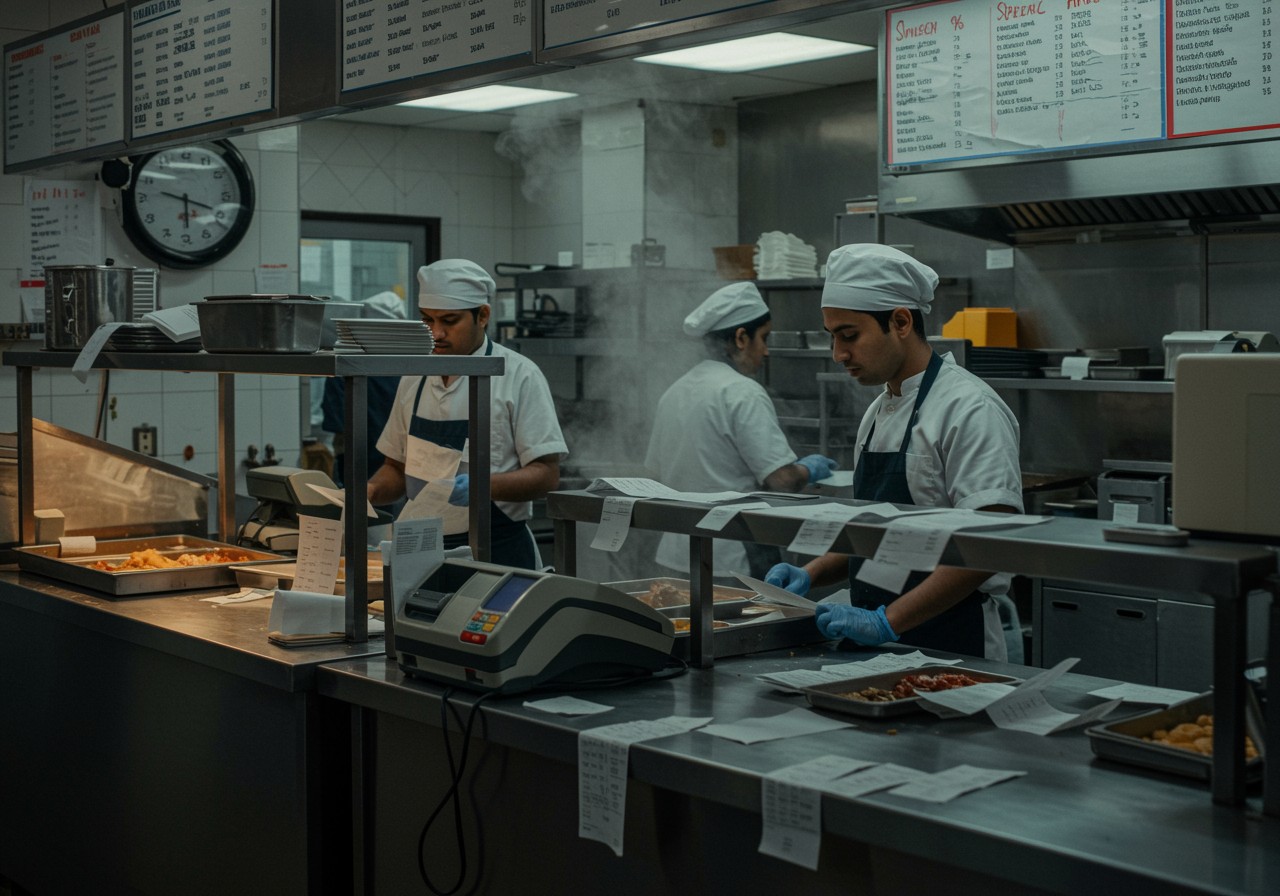
old-school receipt system was causing chaos
Rethinking
the System
Rethinking
the System
To truly improve cafeteria operations, we needed to optimise kitchens operation handling high-volume of orders.
This led to the idea of building a niche Vendor POS & Kitchen System with menu & inventory management deeply connected to the customer app creating an ecosystem rather than two apps in silos.
To truly improve cafeteria operations, we needed to optimise kitchens operation handling high-volume of orders.
This led to the idea of building a niche Vendor POS & Kitchen System with menu & inventory management deeply connected to the customer app creating an ecosystem rather than two apps in silos.
Phy-gital 1st
Solutions
Phy-gital 1st
Solutions
Our idea was to amplify existing user behaviours
- Touch screen based POS through habitual use, instead of PC's.
- During peak hours they multitask constantly, so the interface must be instantly scannable.
We designed a simple touch-screen POS with a minimalist UI, large typography, clear visual cues, and a FIFO (First-In, First-Out) order priority system.
We imported our POS hardware internationally from Korea and fine tuned the hardware with our Kitchen Sytem platform. This served two key purposes.
Operational Benefit: Dedicated hardware simplified setup and ensured consistent performance across cafeterias.
Business Opportunity: It also introduced a new revenue stream.
Vendors paid a monthly subscription for the hardware, allowing HungerBox to generate recurring revenue while deploying the platform.
The Kitchen Sytem worked wonders, it was self explanatory, reduced man power & ops cost in each cafeteria & helped us achieve a company goal of CM1 profitability.
Our idea was to amplify existing user behaviours
- Touch screen based POS through habitual use, instead of PC's.
- During peak hours they multitask constantly, so the interface must be instantly scannable.
We designed a simple touch-screen POS with a minimalist UI, large typography, clear visual cues, and a FIFO (First-In, First-Out) order priority system.
We imported our POS hardware internationally from Korea and fine tuned the hardware with our Kitchen Sytem platform. This served two key purposes.
Operational Benefit: Dedicated hardware simplified setup and ensured consistent performance across cafeterias.
Business Opportunity: It also introduced a new revenue stream.
Vendors paid a monthly subscription for the hardware, allowing HungerBox to generate recurring revenue while deploying the platform.
The Kitchen Sytem worked wonders, it was self explanatory, reduced man power & ops cost in each cafeteria & helped us achieve a company goal of CM1 profitability.
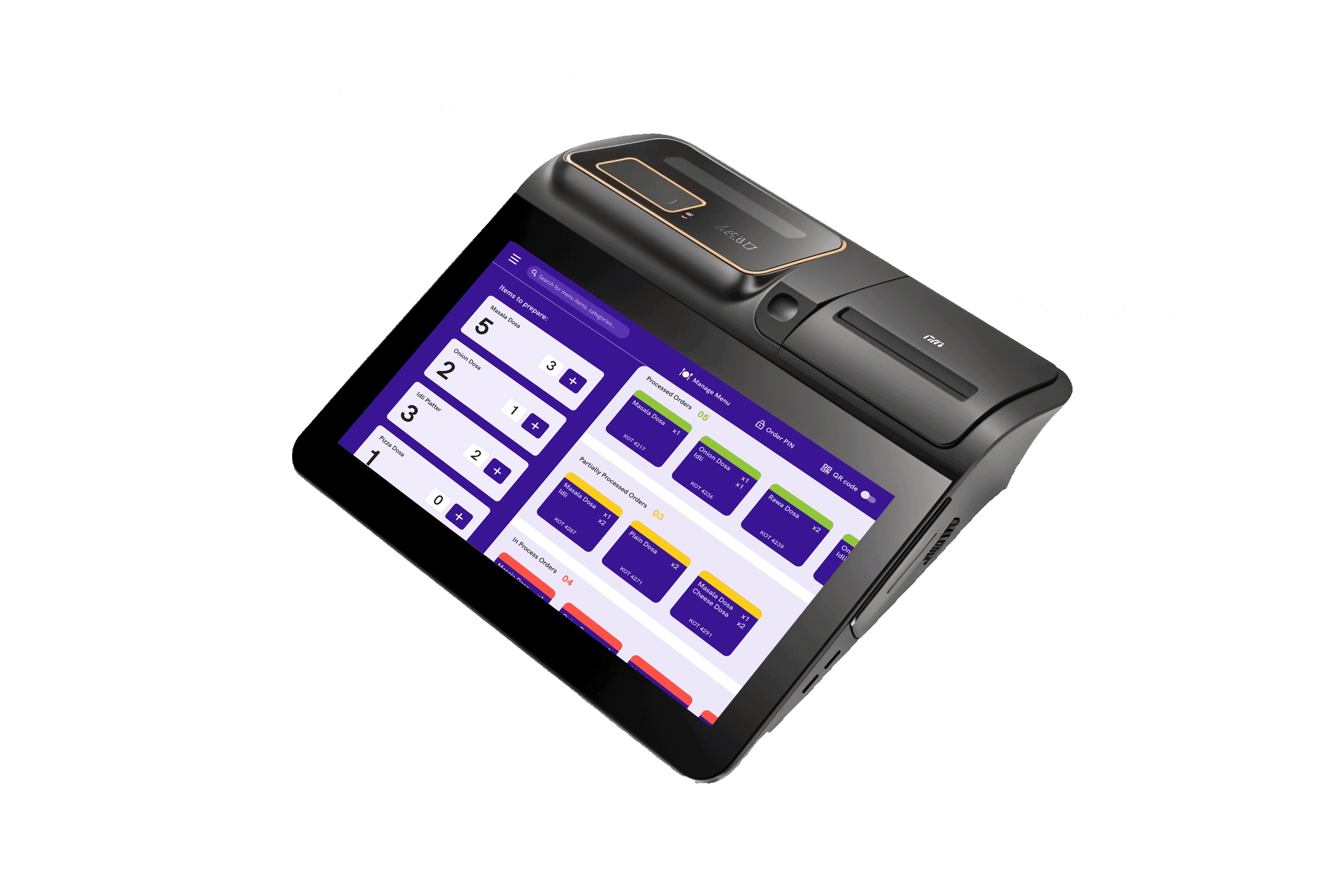
this was the new hardware that we procured
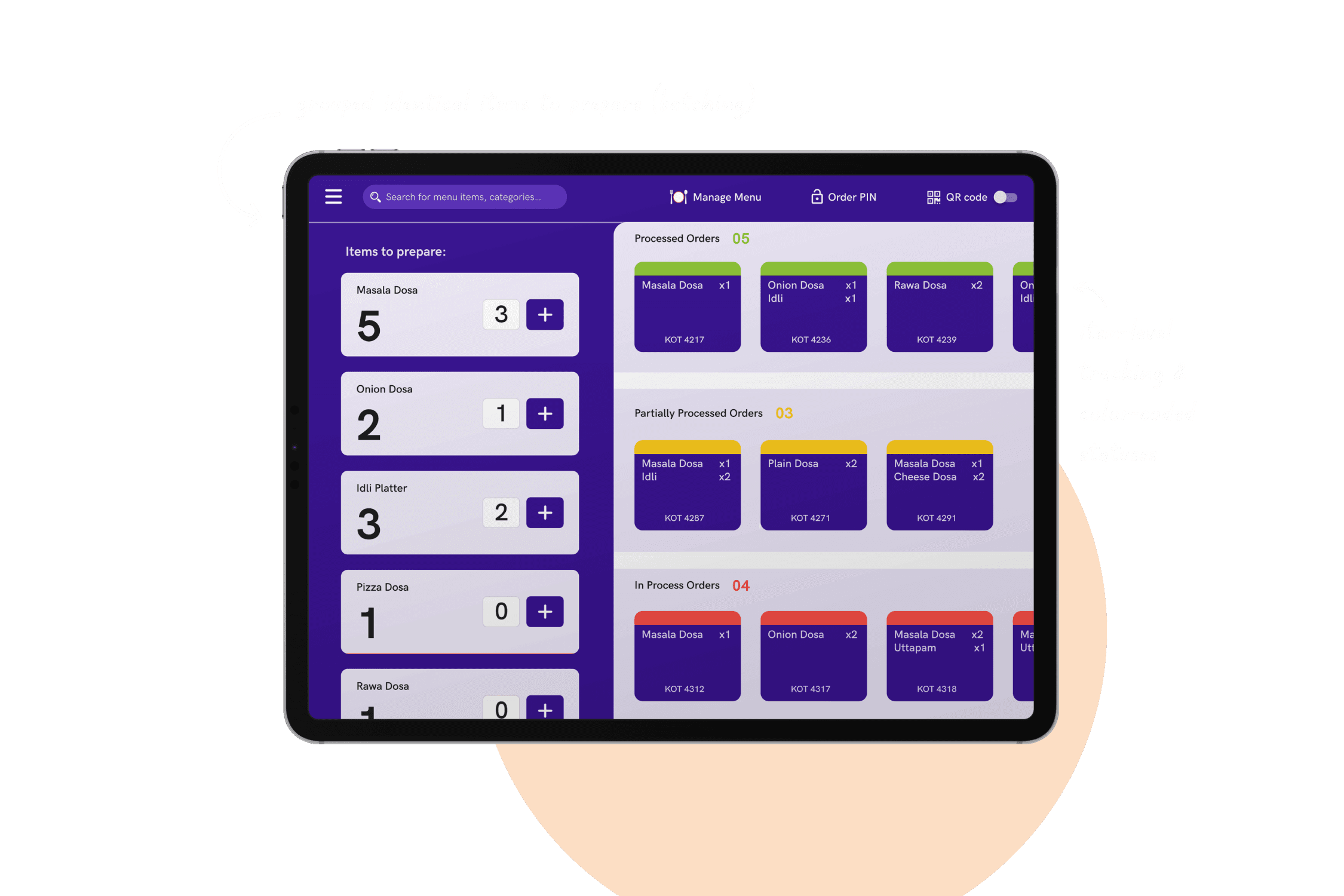
this is the display vendors refer for food preparation
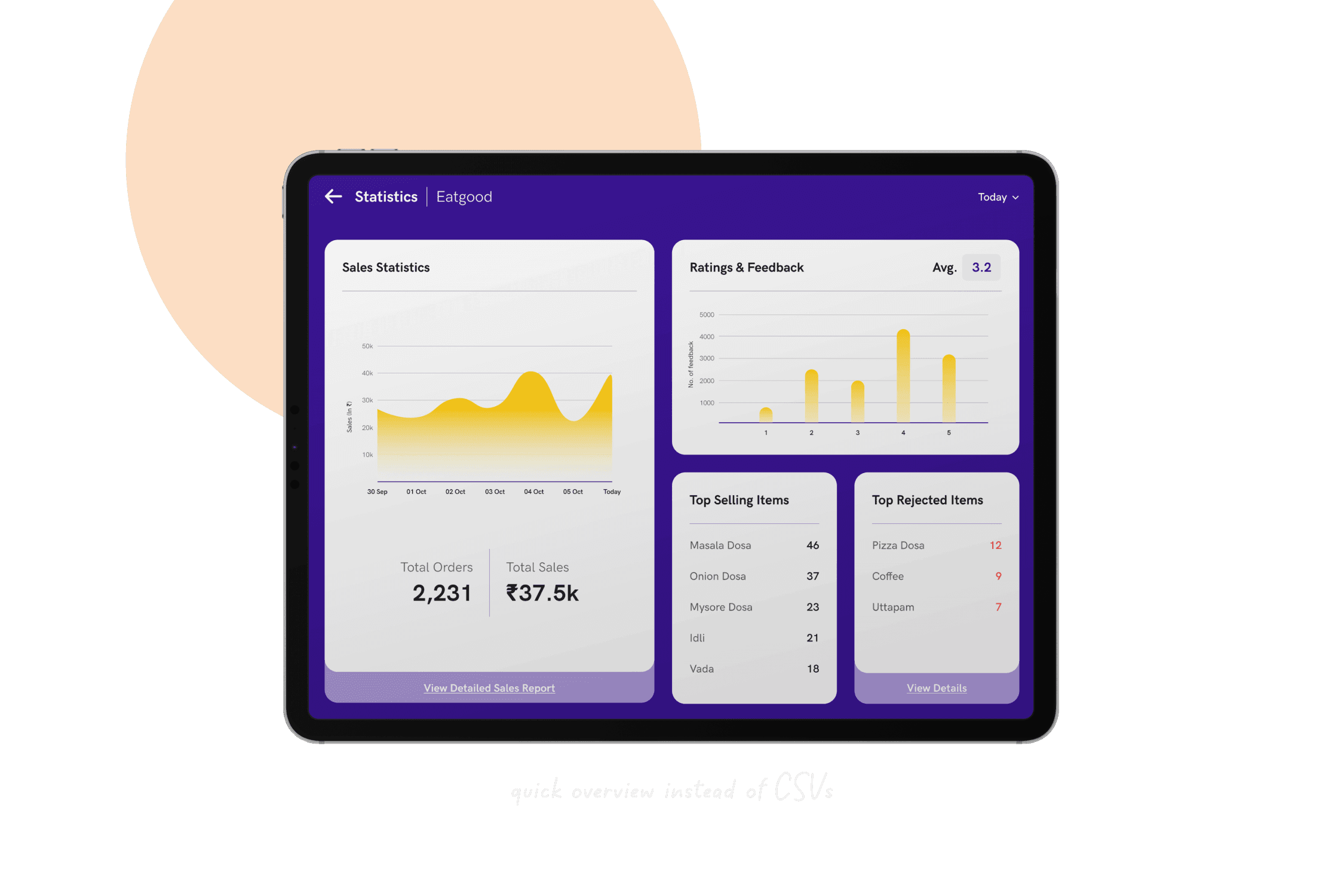
vendors can now view and download reports quickly
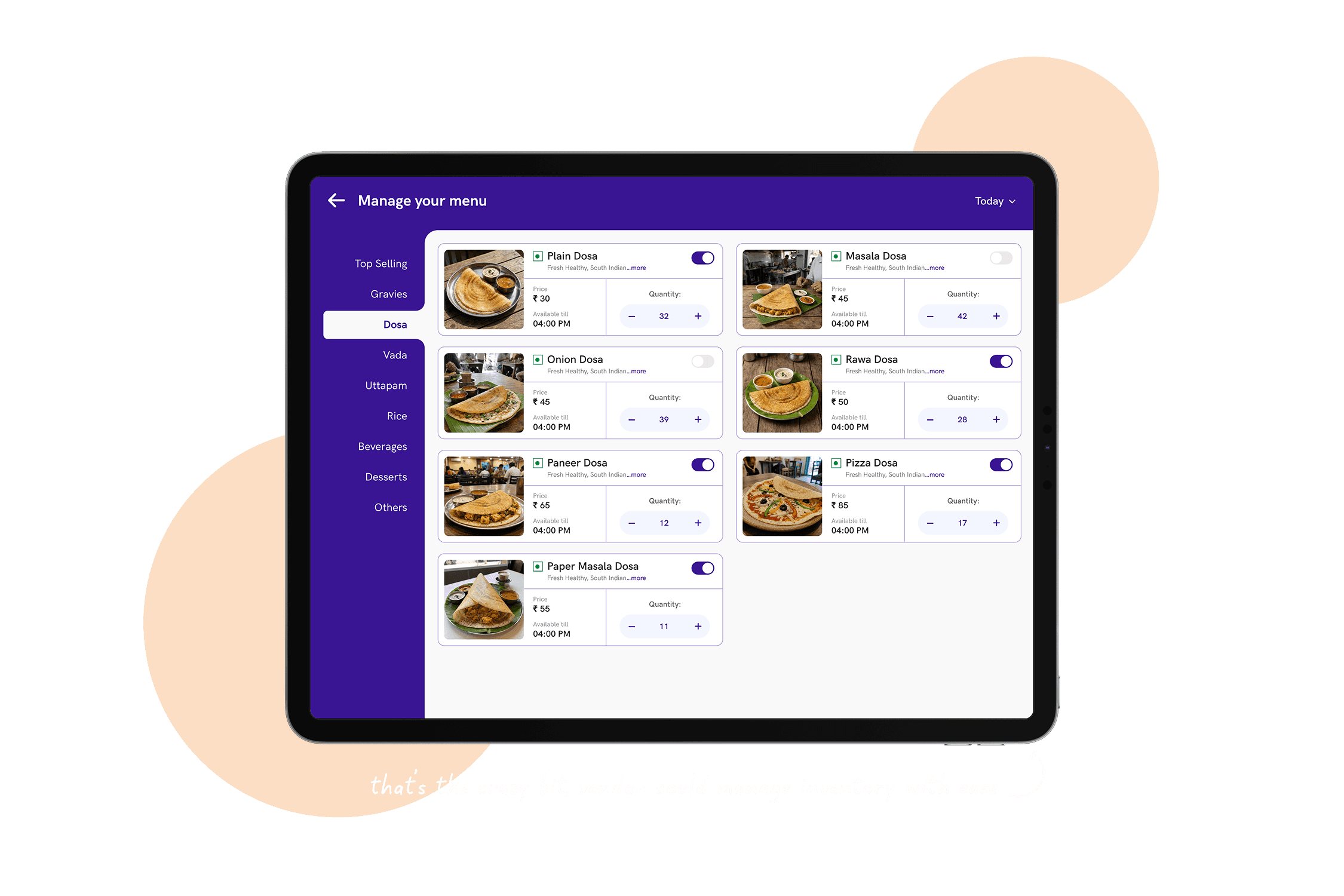
easy managing the inventory
allright the core pain point is solved
allright the core pain point is solved
but there were other challenges!
but there were other challenges!
Navigating through
Payment Failures
Navigating through
Payment Failures
In India, UPI powers ~80%+ of all digital transactions, making it the default payment method for most cafeteria users. However, shaky internet coupled with bank & NPCI server issues frequently caused payment failures during peak lunch hours, leading to longer queues, and disrupted cafeteria operations.
To prevent this scenario, we introduced two fallback mechanisms.
Pay Later: Employees could place orders even if payment systems were down, with post order txn settlement
Offline Ordering: If payment outages occurred, users could place orders directly on the vendor POS.
The system recorded outstanding balances, which could be settled later.
These mechanisms ensured cafeterias could continue operating even during infrastructure failures.
In India, UPI powers ~80%+ of all digital transactions, making it the default payment method for most cafeteria users. However, shaky internet coupled with bank & NPCI server issues frequently caused payment failures during peak lunch hours, leading to longer queues, and disrupted cafeteria operations.
To prevent this scenario, we introduced two fallback mechanisms.
Pay Later: Employees could place orders even if payment systems were down, with post order txn settlement
Offline Ordering: If payment outages occurred, users could place orders directly on the vendor POS.
The system recorded outstanding balances, which could be settled later.
These mechanisms ensured cafeterias could continue operating even during infrastructure failures.
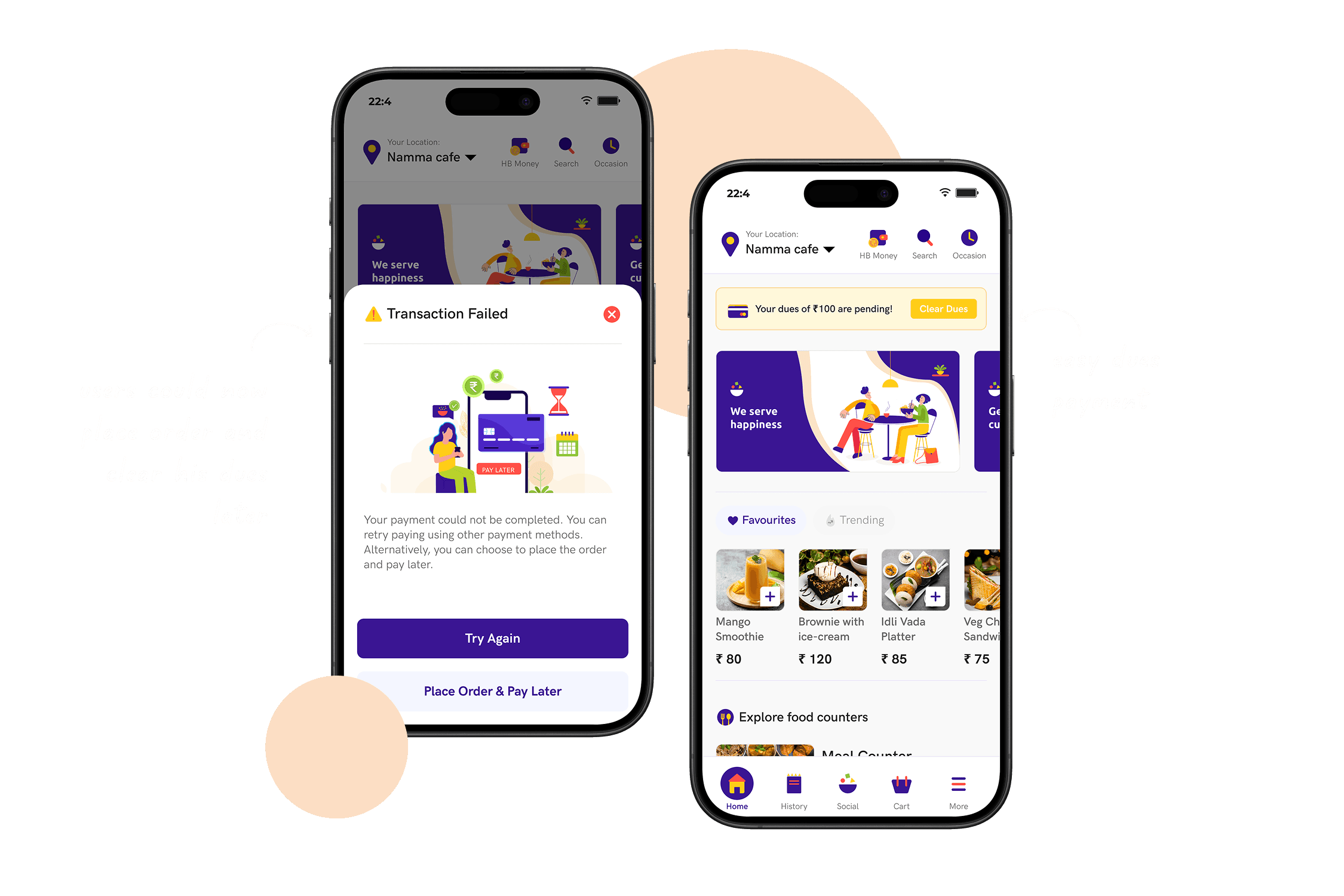
pay later in case of payment failure
while payments were being optimised for
while payments were being optimised for
we faced new client restrictions
we faced new client restrictions
What if mobile phones are not allowed
What if mobile phones are not allowed
Imagine a client tells you "I want HungerBox's product suite" but…. no mobile & no app :').
Tap Ordering with NFC cards: Employees were issued NFC cards linked to their wallet accounts.
They could simply tap their card on the POS device to place orders instantly.
Facial Recognition-Based Ordering: To further reduce friction, we experimented with face recognition-based ordering, allowing employees to identify themselves without using phones or cards.
Imagine a client tells you "I want HungerBox's product suite" but…. no mobile & no app :').
Tap Ordering with NFC cards: Employees were issued NFC cards linked to their wallet accounts.
They could simply tap their card on the POS device to place orders instantly.
Facial Recognition-Based Ordering: To further reduce friction, we experimented with face recognition-based ordering, allowing employees to identify themselves without using phones or cards.
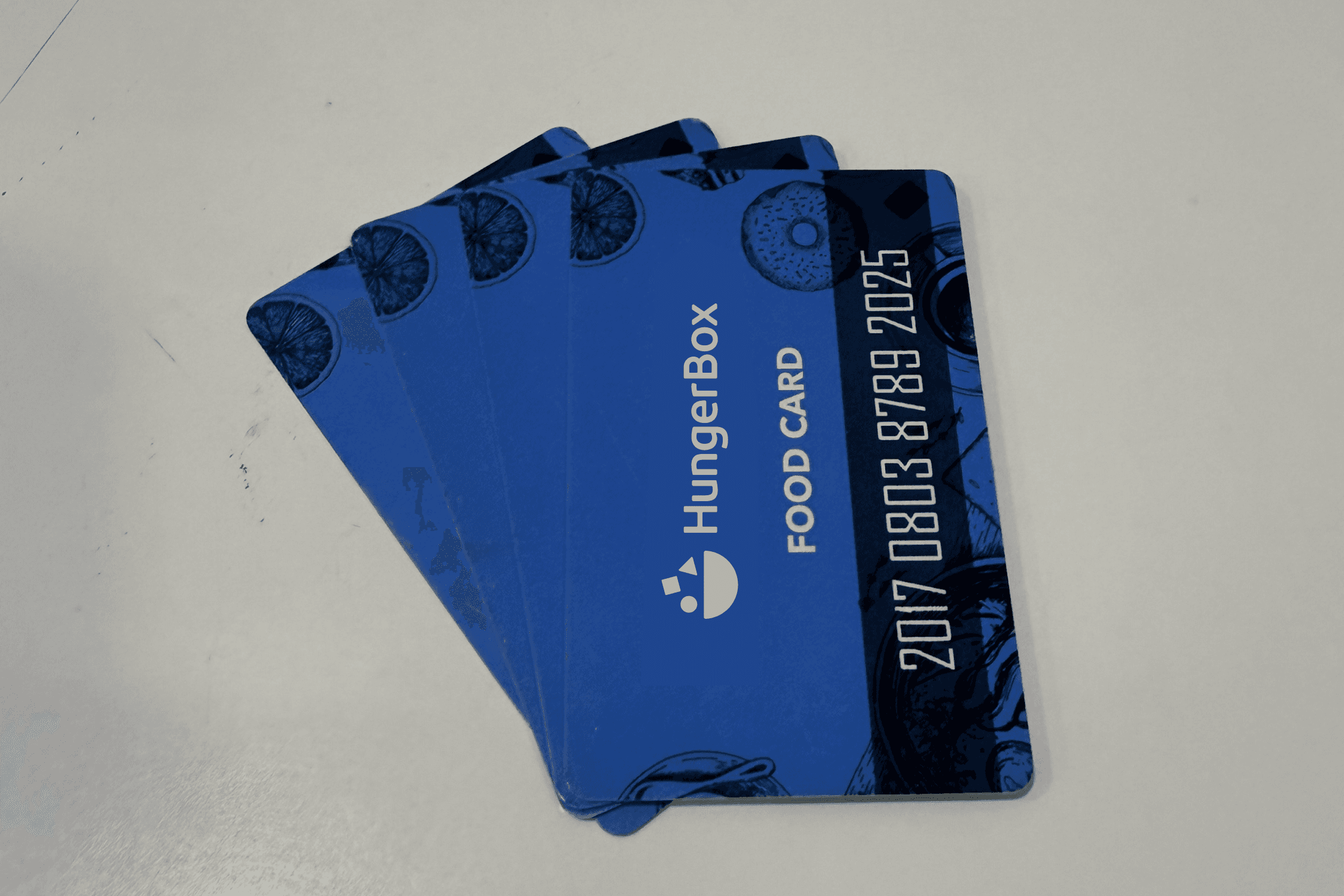
users can tap these cards and place order on kitchen system
Impact
Impact
Customer Experience Impact:
app ratings doubled from 2.3 to 4.2 over a period of 2 years
App NPS increased by 12 points
Operational Impact:
~98% vendor adoption of the kitchen system within 6 months
95th percentile wait time reduced from 60 mins to 25 mins
# of orders/ vendor during peak hours increased by 14pp
Business Impact:
Direct Annual revenue ~5Cr from Vendor POS & Kitchen Sytem
Client Contracts worth 10 Crs closed for big manufacturing clients in tier 2 locations through Tap Ordering & Wallet
Customer Experience Impact:
app ratings doubled from 2.3 to 4.2 over a period of 2 years
App NPS increased by 12 points
Operational Impact:
~98% vendor adoption of the kitchen system within 6 months
95th percentile wait time reduced from 60 mins to 25 mins
# of orders/ vendor during peak hours increased by 14pp
Business Impact:
Direct Annual revenue ~5Cr from Vendor POS & Kitchen Sytem
Client Contracts worth 10 Crs closed for big manufacturing clients in tier 2 locations through Tap Ordering & Wallet
What stuck with me
What stuck with me
Looking back, the most important shift in this project was moving from interface design to system design.
What began as an effort to improve a food ordering app eventually evolved into designing a complete operational platform for enterprise cafeterias.
This experience reinforced the importance of thinking beyond screens and designing products that work within complex real-world systems.
Looking back, the most important shift in this project was moving from interface design to system design.
What began as an effort to improve a food ordering app eventually evolved into designing a complete operational platform for enterprise cafeterias.
This experience reinforced the importance of thinking beyond screens and designing products that work within complex real-world systems.
thank you!
keep exploring
thank you!
keep exploring


Bringing ideas
to life,
one product
at a time
Made with 🔥

Bringing ideas to life,
one product at a time
Made with 🔥